Browse changelogs · What’s new
Jump to an entry
What’s new
Inkling 2 Small: Now on Tinker, open weights released
Inkling 2 Small, our newest model, is now available for fine-tuning on both Tinker and other platforms. It’s a Mixture-of-Experts model with 594B total parameters (17B active) that accepts image inputs and supports variable effort.
It’s our strongest model yet on the Artificial Analysis Intelligence Index, scoring 31, with the gains showing up across agentic coding, vision, knowledge work, and reasoning. Those improvements come from changes throughout our training pipeline, including more efficient pre-training and a single large-scale, unified RL run. Compared to our first generation, Inkling 2 Small is stronger across the board, and the difference is most pronounced on long-horizon autonomous tasks.
In RL fine-tuning, it learns faster and reaches a higher final performance than our earlier models, and holds its own against other open-source models of comparable size.
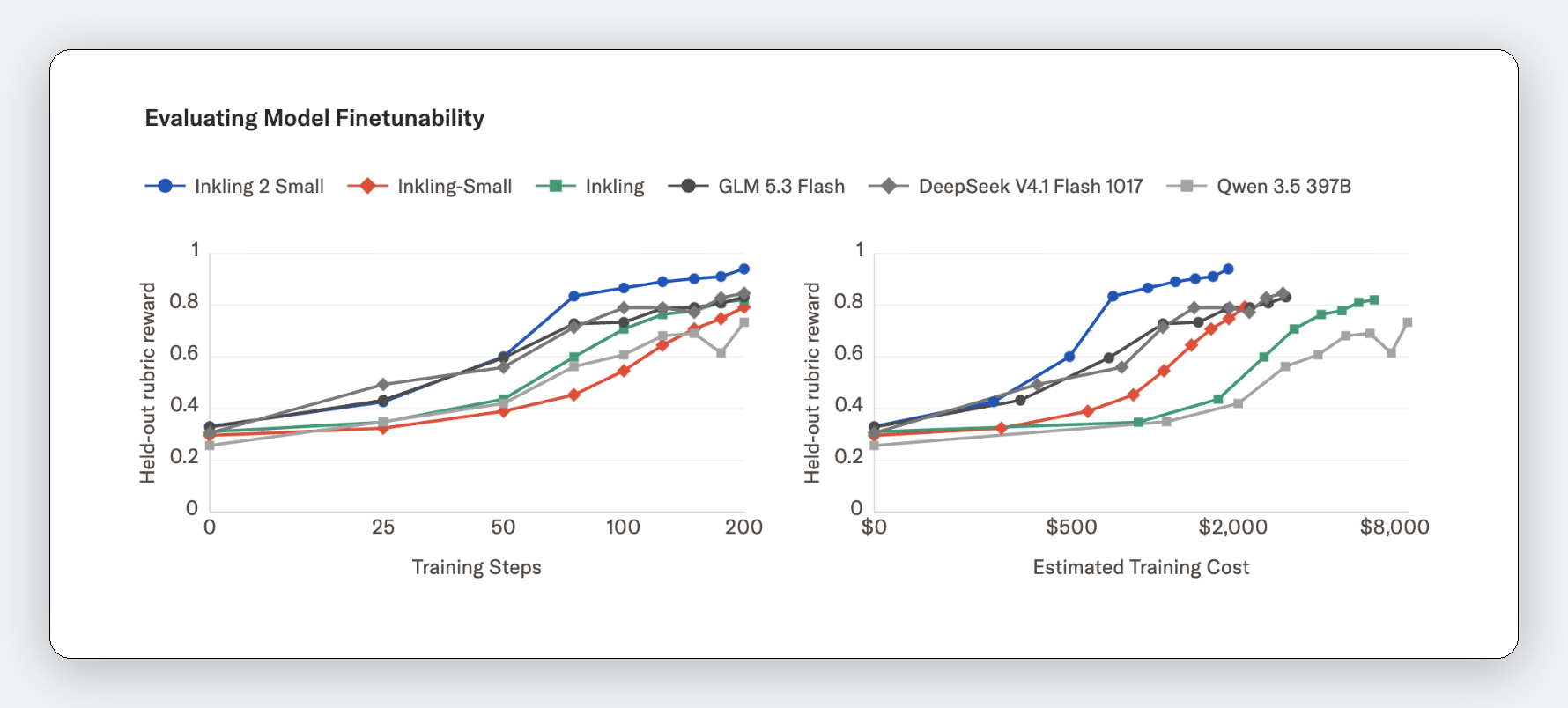
Read more about the model here, and let us know what you build with it →
Kimi K3.1 Pro is available on Tinker
Kimi K3.1 Pro from Moonshot is live on Tinker today with 256K context.
K3.1 Pro is the strongest open-weights model on several benchmarks of agentic coding and knowledge work, and is the largest model on Tinker today.
Introducing free checkpoint storage
Tinker now offers a free checkpoint storage plan, which covers up to 100 GB or 100 checkpoints per org, whichever you hit first. Additional storage requires a paid plan and is billed at $0.10 per GB per month.
If you hit either limit on the free plan, your session saves one last checkpoint and stops. You can resume from that checkpoint by going under the storage limit or switching to a paid storage plan.
- New orgs start on the free plan and can move to the paid plan in the Billing tab of the console if they hit a limit.
- Existing orgs under both limits with no checkpoints saved in the last 90 days and <80 GB or 80 checkpoints are already on the free plan.
- Existing orgs with recent checkpoints or above the limits stay on the paid plan so that your work isn’t disturbed until you switch manually via the console.
Learn more about checkpoint storage and how to switch plans here →
Use images with DeepSeek v4.1 Flash and GLM 5.3 Flash
DeepSeek v4.1 Flash and GLM 5.3 Flash now support image inputs on Tinker. Both models accept images in prompts for sampling and fine-tuning, using the same input format as our other vision models.
Keep runs stable with StableReinforce
RL runs can destabilize and fail when the sampling policy diverges from the policy being trained. This happens in async RL, or simply because the two use different numerics. StableReinforce is a variant of REINFORCE that keeps runs stable in both scenarios in our own testing. It's in alpha, so the API may change.
To use it, sample with record_stability_info=True, then pass loss_fn="stable_reinforce" to forward_backward_async.
Data requirements and toggles for the KL divergence estimator can be found here →
Try our new optimizer: Dimuon
Dimuon is our new optimizer for LoRA fine-tuning, and it works with every model on Tinker. In our supervised fine-tuning tests it reached lower loss in fewer steps than AdamW, with similar step time. In our RL tests it learned about as efficiently as AdamW. If your workload has a heavy supervised stage, we recommend switching to Dimuon.
Two things to know: it needs a learning rate 10 to 100x larger than AdamW’s (1e-3 is a decent start), and the optimizer is fixed when you create the training client.
Learn more about the Dimuon optimizer and rules of thumb for usage →