Async RL
Asynchronous (async) RL overlaps sampling with training to save wall-clock time. In synchronous (sync) RL, each step samples a batch, waits for its slowest rollout, and then trains, so sampling and training take turns sitting idle. In async RL, the trainer trains on finished rollouts while new ones keep sampling.
Because sampling runs ahead, the trainer often trains on stale rollouts, sampled by weights from several steps earlier. Letting sampling run further ahead raises throughput but also staleness, and you set this tradeoff with sampling_steps_ahead. Stale data can make RL training unstable, so by default the cookbook handles it in two ways: in-flight weight updates keep rollouts fresher, and StableReinforce, the default loss, is built to stay stable on off-policy data.
How async RL works
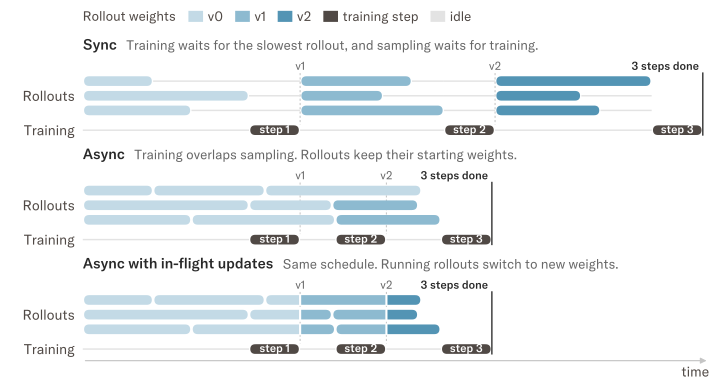
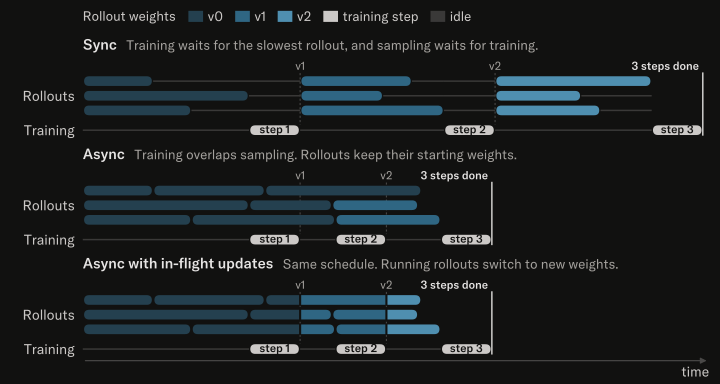
Figure 1. Sync and async training schedules.
Figure 1 runs the same rollouts through both schedules. Sync finishes last, because each batch waits for its slowest rollout and then for the step to train. In async RL, sampling keeps going while the trainer trains, and each training step takes the next batch of finished rollouts. After each step, the trainer publishes new weights for the rollouts that start afterwards. How much time this saves depends mostly on how uneven rollout lengths are and how long training takes compared with sampling.
Sampling can't run arbitrarily far ahead: sampling_steps_ahead caps how many groups (the rollouts for one prompt) can be sampling or waiting to be trained at once. Most groups end up about that many steps stale, but it isn't a hard limit, since a long rollout can finish many steps after it started.
Training on stale data
In-flight weight updates
With in-flight weight updates, rollouts that are still generating switch to each step's new weights as they propagate, instead of finishing on the weights they started with. Long responses benefit most, since more steps pass while they generate. The cookbook does this with Tinker's inflight sampling, saving each step's weights with save_weights_and_get_sampling_client(kind="inflight"). They're on by default; to keep each rollout on its starting weights, set inflight_weight_updates=False.
Evals are unaffected: each one samples from a snapshot of its step's weights, so it measures one fixed policy.
StableReinforce
Even with in-flight updates, most groups were sampled by an older policy than the one being trained, and the two drift further apart as staleness grows. Common RL losses such as importance sampling, PPO and CISPO correct for this gap with a per-token ratio between the two policies, computed from the logprobs returned at sampling time. This works well when the policies are close, but gets harder to keep stable as they drift apart.
StableReinforce (stable_reinforce), the default loss for async runs, is a REINFORCE variant built to stay stable when the two policies are far apart. Besides the sampled logprobs, it uses information Tinker records at sampling time. In our internal post-training, it has stayed stable even when async RL runs far off-policy. The loss also includes a KL term between the sampler and the learner, which you can tune through loss_fn_config (see the StableReinforce page).
A stable loss doesn't make stale data as useful as fresh data. Groups sampled many steps ago say less about the current policy, so sampling far ahead can slow learning per step. Even so, the cookbook never drops groups for being stale: the stalest are usually the longest responses, so dropping them would bias training toward short ones.
Set up async training
Configure AsyncConfig
Async training is off unless you pass an AsyncConfig to the RL Config:
from tinker_cookbook.rl.train import AsyncConfig, Config

config = Config(
    ...,
    # Train 32 groups per step, with sampling running up to 2 steps ahead.
    async_config=AsyncConfig(groups_per_batch=32, sampling_steps_ahead=2),
)
groups_per_batch is the number of groups each step trains, usually your dataset's batch size. sampling_steps_ahead is how many steps sampling may run ahead of training, where 0 means on-policy. It replaces max_steps_off_policy, which still works but is deprecated. The loss comes from AsyncConfig.loss_fn (default stable_reinforce), not Config.loss_fn. The API reference lists every field and its default.
The math_rl, code_rl, rubric and harbor_rl recipes take sampling_steps_ahead as a flag. This runs math RL with sampling up to two steps ahead:
python -m tinker_cookbook.recipes.math_rl.train env=math \
    model_name="Qwen/Qwen3.5-9B" renderer_name=qwen3_5_disable_thinking \
    max_tokens=2048 group_size=16 groups_per_batch=64 learning_rate=2e-5 \
    sampling_steps_ahead=2
Choose how far ahead to sample
sampling_steps_ahead works through a buffer of groups that sampling and training share. A group takes a slot when its rollouts start and frees it once it's trained, and the buffer holds sampling_steps_ahead + 1 steps' worth of groups (Figure 2). Groups dropped after rollout errors (with a tolerant rollout_error_tolerance) or filtered out by remove_constant_reward_groups=True don't count toward a step, which waits until it has groups_per_batch groups.


Figure 2. The group buffer.
Since new groups take freed slots right away, the buffer stays full, and most groups are about sampling_steps_ahead steps stale by the time they're trained (Figure 3, from the example runs). Groups come out fresher early in a run, before sampling gets ahead, and whenever the trainer is waiting on rollouts.
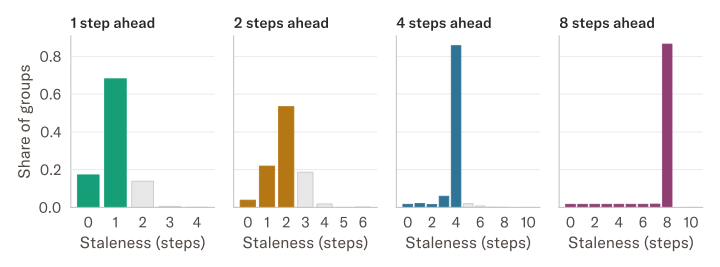
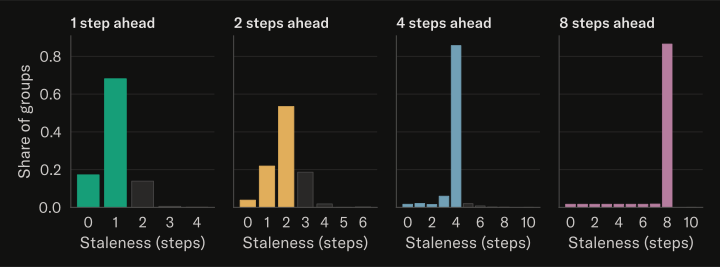
Figure 3. Staleness of trained groups.
How far ahead to sample trades speed for staleness. Speed improves as sampling_steps_ahead grows, until slow rollouts no longer hold up training; past that point, running further ahead only adds staleness. Workloads with long or uneven rollouts, such as multi-turn agents or long reasoning, gain the most.
sampling_steps_ahead=2 is a reasonable default. In the example, it ran about 5× as many steps per hour as sync, with held-out accuracy matching sync. To tune it for your workload, try a few values on short runs of about 20 steps and compare wall-clock time per step. Pick the smallest value that gets most of the speedup, then check on a longer run that held-out evals keep up with a lower value.
Two limits also apply. At the start of a run, (sampling_steps_ahead + 1) × groups_per_batch groups begin before the first update, so for short runs where that's a large share of the dataset, use a smaller value. And up to (sampling_steps_ahead + 1) × groups_per_batch × group_size rollouts run at once, so size sandbox pools and executors for that (API reference).
Hung rollouts and resuming
A hung rollout keeps its buffer slot, so enough of them will stall training. If your environment can hang, set rollout_error_tolerance to a RetryOnFailure with a per_rollout_timeout. Don't add your own timeouts around Tinker calls, since the SDK already handles slow requests.
To resume a run, rerun it with the same log_path. Training picks up from the last checkpoint, but rollouts in flight are lost, so a few prompts near the resume point can be trained twice or skipped.
Monitor a run
The cookbook logs training metrics to metrics.jsonl in your log_path, and to Weights & Biases when you set wandb_project (and optionally wandb_name) in your Config. A name ending in * stands for a family of metrics, such as async/staleness_min, async/staleness_mean and async/staleness_max.
async/staleness_*is the age, in training steps, of the weights that sampled each trained group. With in-flight updates it counts the oldest weights, so it overstates staleness for later tokens (details).optim/kl_sample_train_*estimates the KL between the sampling and training policies on the trained tokens (details). A high or growing value means the data is far off-policy.
Track progress with held-out evals (eval_every) rather than training reward. Training reward comes from rollouts sampled by older weights, so it lags behind the current policy.
Example: sync vs. async on code RL
We compared sync training with async sampling one, two, four and eight steps ahead on the same code RL setup. We trained Qwen3.5-4B with LoRA (rank 32) on DeepCoder code problems and graded responses by running the tests in a sandbox. Each step trains on 16 groups of 16 samples with stable_reinforce and a learning rate of 4e-5. Thinking is off and responses are capped at 16K tokens. We timed each setting on its own with evals off, and measured accuracy with separate 60-step runs on 256 held-out problems.
Async ran 3–8× faster than sync, with most of the gain reached by four steps ahead. With one or two steps, held-out accuracy matched sync. With four or eight, it trailed by a couple of points (Figure 4).
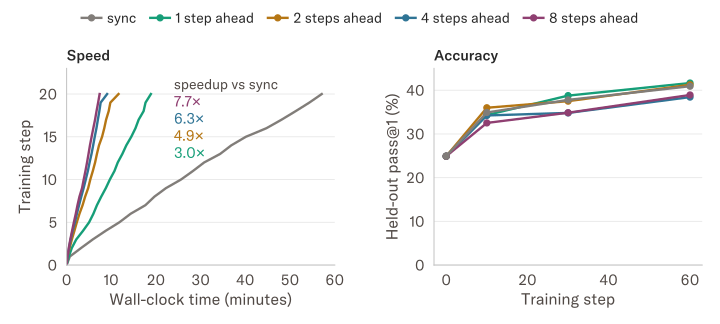
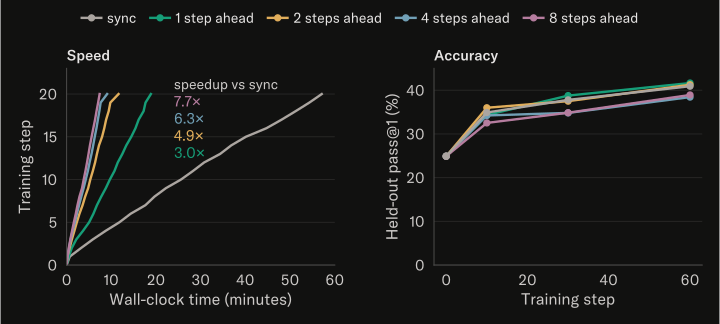
Figure 4. Speed and held-out accuracy, sync vs. async. Left: wall-clock time for the first 20 training steps. Right: held-out pass@1 on DeepCoder, averaged over two seeds.